
What does meaningful progress in EDI actually look like?
As sponsors of this year’s Equality, Diversity and Inclusion Award at the Times Higher Education Awards, we’ve been reflecting on a question that is becoming increasingly important across the sector: How do we know whether progress in EDI is actually being achieved? Over the past decade, higher education institutions have invested significant time, energy and resources into equality, diversity and inclusion initiatives. New strategies have been developed, networks established, targets introduced and conversations encouraged. These developments matter. However, as the EDI agenda continues to mature, there is growing recognition that success cannot be measured solely by activity. The real challenge is understanding impact. Moving beyond good intentions Most universities can point to policies, programmes and initiatives designed to improve inclusion and widen participation. The more difficult question is whether these initiatives are creating meaningful and lasting change. Are opportunities becoming accessible to a broader range of people? Are leadership teams becoming more representative? Are talented individuals from under-represented backgrounds progressing into senior positions? Are institutions creating environments where diverse perspectives can genuinely influence decision-making? These are not simple questions, but they are increasingly important ones. Why leadership matters Leadership plays a critical role in shaping institutional culture, priorities and performance. The decisions made by executive teams and governing bodies influence everything from student experience and workforce development through to innovation, research and long-term strategy. This is why conversations around EDI and leadership are so closely linked. Creating more inclusive pathways into leadership is not simply about representation. It is about ensuring institutions have access to the broadest possible range of skills, experiences, perspectives and talent. The strongest leadership teams are often those capable of drawing upon different viewpoints, challenging assumptions and responding effectively to increasingly complex environments. Measuring what matters As an executive search and leadership advisory firm, we believe organisations have a responsibility not only to talk about diversity, but to measure progress. At Veredus, we regularly audit our own recruitment outcomes to understand how effectively diverse talent progresses through the search process. Between 2021 and 2024: 53% of appointed candidates were women 21% were from ethnic minority backgrounds 8% identified as LGBTQ+ 7% identified as having a disability These figures do not represent an end point, nor do they suggest the work is complete. However, they reinforce an important principle: meaningful progress should be measurable. Transparency creates accountability, while measurement helps organisations understand where progress is being made and where further action may be needed. Celebrating impact across higher education One of the reasons we are proud to sponsor the Equality, Diversity and Inclusion Award at the Times Higher Education Awards is that it recognises institutions and individuals who are delivering tangible impact. The most effective EDI initiatives are characterised by evidence, outcomes and sustained commitment. Whether through widening participation, improving access to leadership opportunities, supporting social mobility or creating more inclusive institutional cultures, these initiatives are helping to shape the future of higher education. At Veredus, we believe that celebrating these achievements is important. Not simply because they recognise excellence, but because they encourage learning, challenge assumptions and help raise standards across the sector. As the higher education landscape continues to evolve, the institutions that succeed will be those that recognise inclusion is not a standalone initiative. It is a strategic imperative that influences talent, leadership, innovation and organisational performance. We look forward to celebrating the individuals and institutions leading that progress at this year’s Times Higher Education Awards. Find out more about our track record in providing executive search, interim solutions and strategic talent advisory services to the Education sector. LEARN MORE
What makes a great Interim Management provider?

Lessons from a market built on trust The interim management market has evolved significantly over the past decade. As organisations face increasing pressure to deliver transformation, manage financial constraints, navigate regulatory scrutiny and accelerate strategic change, interim leaders have become a critical component of organisational success. However, while much attention is often placed on selecting the right interim executive, less discussion is given to the role of the interim management provider itself. The quality of the provider can have a significant impact on the success of an appointment, influencing everything from candidate quality and speed of delivery to cultural fit, stakeholder confidence and long-term outcomes. This is possibly why the Institute of Interim Management (IIM) Survey remains one of the most respected benchmarks in the sector. Unlike many industry awards, rankings are based entirely on feedback from the interim community, providing an independent assessment of how providers are perceived by the market. In the 2026 survey, Veredus achieved Gold Award recognition and a top 20 ranking overall. While we are proud of this achievement, it also prompted an important question: What actually makes a great interim management provider? Understanding the client challenge before the search begins The best interim appointments are not usually about replacing a vacancy. More often, organisations require experienced leaders to solve specific challenges: Delivering organisational transformation Leading restructuring or turnaround programmes Stabilising critical functions Managing periods of significant growth Providing specialist expertise during times of change Delivering strategic programmes with limited internal capability A strong interim provider begins by understanding the challenge itself rather than simply focusing on the job description. This distinction is important because successful interim appointments are defined by outcomes, not activities. Market knowledge matters more than ever The interim market has become increasingly competitive. Senior leaders today have more options, greater flexibility and higher expectations regarding assignments. At the same time, organisations are operating within increasingly complex environments, particularly across sectors such as government, defence, transport, infrastructure and higher education. Providers must therefore do more than maintain candidate databases. They need a deep understanding of: Leadership capability requirements Sector-specific challenges Regulatory and governance considerations Market availability Emerging leadership trends This level of market intelligence allows organisations to make informed decisions and access talent that may not be visible through traditional recruitment channels. The human element remains critical Artificial intelligence and automation are increasingly shaping recruitment processes. Technology undoubtedly has a role to play in improving efficiency, streamlining administration and enhancing market intelligence. However, interim leadership appointments remain fundamentally human decisions. The most successful appointments often depend on factors that cannot be easily quantified: Leadership style Stakeholder management capability Political awareness Cultural fit Judgement under pressure Ability to influence complex environments Understanding these qualities requires conversation, experience and professional judgement. The most effective providers combine technology with human expertise rather than replacing one with the other. Candidate experience influences market reputation One of the strongest indicators of provider quality is candidate feedback. Senior interims invest significant time and effort into building their careers and reputations. They expect transparency, communication and professional engagement throughout the recruitment process. Providers that consistently demonstrate respect, honesty and professionalism build stronger networks and attract higher-calibre talent. Over time, this creates a virtuous cycle where better candidate relationships lead to stronger client outcomes. Why trust remains the ultimate differentiator Despite advances in technology, changing market conditions and evolving organisational requirements, one factor continues to underpin successful interim management: trust. Clients need confidence that providers understand their challenges. Candidates need confidence that providers represent opportunities accurately and professionally. Boards and executive teams need confidence that recommended leaders can deliver results in complex environments. Trust is difficult to measure but easy to recognise. It is built through consistency, expertise, transparency and delivery over time. Looking ahead The demand for experienced interim leaders is unlikely to diminish. Organisations across the public and private sectors continue to face unprecedented levels of change, complexity and scrutiny. As a result, the quality of leadership appointments has never been more important. For organisations selecting an interim management provider, the question should extend beyond speed of delivery or access to talent pools. The more important question is whether that provider has the expertise, judgement, relationships and market credibility to deliver leaders who can succeed in demanding environments. About Veredus Veredus is a specialist executive talent consultancy providing interim management, executive search and leadership advisory services across defence, transport, central government and higher education. In the 2026 Institute of Interim Management Service Provider Survey, Veredus achieved Gold Award recognition and ranked within the UK’s top 20 providers, based entirely on feedback from the interim management community. LEARN MORE
The Rise of Transnational Education

Implications for Strategy, Risk and Leadership in UK Universities Transnational education (TNE) has become an increasingly important component of the UK’s international higher education activity, allowing institutions to deliver programmes to students overseas through partnerships, joint degrees and offshore provision. While research-intensive institutions have long participated in TNE, for many it has not traditionally been a central pillar of their international strategy. However, there are increasing indications that more research-intensive institutions are expanding their engagement with TNE, raising questions about how this aligns with the traditional research-intensive model and its priorities. This shift reflects a combination of financial pressures within the UK funding model, greater uncertainty around international student recruitment, and intensifying global competition, alongside opportunities to maintain international reach and presence. This raises important questions not only about institutional strategy, but also about whether existing leadership structures and capabilities are aligned to support this shift. Recent announcements – such as the University of Exeter’s plans to establish a teaching presence in Cairo, alongside a growing number of UK universities expanding their presence in India, including Southampton and York – illustrate how some institutions are evolving their approach to TNE. The question for the sector is whether this reflects a longer-term strategic repositioning or a more immediate response to current financial and recruitment pressures. Choice of delivery model Branch campuses, joint ventures, dual-degree programmes and partnership-based provision all offer different levels of institutional control and financial exposure. These models often involve a trade-off between institutional control and speed or scale of expansion, requiring careful alignment with institutional risk appetite and brand positioning. While some UK universities have developed extensive international delivery networks through large portfolios of overseas partners, others have focused on a smaller number of strategically significant collaborations, such as joint institutes or dual-degree partnerships that involve closer academic integration. Different arrangements can enable varying levels of academic oversight, influencing the extent to which institutions can align programmes with their research strengths and manage reputational risk while building long-term partnerships in key regions. As institutional reputation is closely tied to perceptions of academic quality and research excellence, maintaining close oversight of teaching, assessment and partner governance is essential to ensuring equivalence with home-campus provision. This highlights the importance of selecting delivery models that both enable growth and are consistent with institutional strengths and risk appetite. These choices also have implications for the type of leadership capability required, particularly in balancing academic oversight, partner governance and commercial considerations across different operating models. Financial sustainability Establishing offshore provision often involves significant upfront investment in partnership development, regulatory approvals, staffing and programme development. In addition, institutions must establish robust legal and regulatory frameworks, including securing local approvals, structuring partnership agreements and ensuring compliance with accreditation and employment requirements. In many cases, programmes delivered overseas are offered at different price points to reflect local market conditions, with fee levels often lower than those for UK-based provision. Returns on investment may therefore take several years to materialise, particularly as student recruitment builds and local partnerships mature. Institutions must also consider the potential for changes in local regulation, political conditions in host countries, market demand and competitive dynamics, all of which can affect the long-term viability of offshore programmes. For research-intensive institutions in particular, this creates a tension between long-term international investment and the need to respond to more immediate financial pressures. For universities that have not traditionally operated at scale in this space, these financial timelines require careful strategic planning, particularly where institutions are balancing long-term international investment against short-term financial pressures. Evolving international leadership roles As a result, senior leaders responsible for international portfolios and campuses will find their roles increasingly involve engagement with foreign ministries, regulators, public authorities and local education partners, alongside their traditional responsibilities. This requires a broader skill set, including the ability to navigate complex regulatory environments, build trusted relationships with government stakeholders, and manage partnerships within different political and policy contexts. This reflects a shift from primarily outward-facing recruitment and partnership roles towards positions that combine strategic, regulatory and operational responsibilities. In practice, this is leading to a convergence between academic leadership, international strategy and commercial capability, creating hybrid roles that are still relatively ill-defined across the sector. While elements of TNE expertise exist across the sector, the combination of large-scale delivery experience and familiarity with research-intensive institutional contexts may be less common. Institutions may therefore need to consider whether to develop this expertise internally or draw on experience from parts of the sector where international delivery is more established. As a result, institutions are increasingly required to define roles that do not yet have clear sector benchmarks, making both role design and appointment more complex. Implications for institutions As institutions expand their engagement with TNE, there are a number of practical considerations emerging around organisational capability and leadership: Defining new leadership roles – Traditional PVC International or Director of Global Engagement roles may not fully reflect the breadth of responsibilities required, particularly where institutions are developing offshore delivery or navigating complex regulatory environments. Accessing the right experience – Experience of large-scale international delivery, regulatory navigation and partnership governance is often concentrated in a relatively small number of institutions globally, making it a constrained and competitive talent market. Balancing internal development and external hiring – Institutions will need to consider where to build capability internally versus where external expertise is required to accelerate delivery or de-risk investment. Understanding the global talent landscape – Effective decision-making in this space increasingly relies on robust market insight, including how peer institutions are structuring roles, where relevant expertise sits globally, and what motivates individuals to move. These shifts are not only strategic but organisational, requiring institutions to reassess how leadership capability is structured, developed and accessed. Conclusion As more universities consider expanding their engagement with transnational education, the challenge is not simply identifying opportunities but ensuring that expansion is underpinned by a clear understanding of risk, capability and long-term strategic fit. The extent to which universities begin to embed TNE within
IIM Interim Management Survey 2026 Now Live
The Institute of Interim Management (IIM) has officially launched its 2026 Interim Management Survey, marking one of the most important moments in the interim calendar. Widely regarded as the leading source of insight into the UK interim market, the survey captures the experiences, challenges and opportunities shaping the profession today. From day rates and assignment trends to sector demand and market confidence, the findings provide a valuable benchmark for both interim managers and hiring organisations. At a time when organisations are navigating increasing complexity, the role of interim leadership continues to evolve. Interims are no longer seen solely as a short-term solution, but as a critical lever for maintaining operational continuity, delivering transformation, and managing risk in high-stakes environments. The IIM survey plays a key role in evidencing this shift, offering data-led insight into how the market is responding. We strongly encourage all interim managers within our network to take part. The strength and credibility of the survey relies on broad participation, ensuring it reflects the full breadth of experience across the interim community. For organisations that rely on interim expertise, the results will offer a clear view of where the market is heading – helping to inform workforce planning, resourcing strategies, and leadership decisions over the year ahead. At Veredus, we remain committed to supporting the interim community and contributing to a more informed, transparent and effective market. Take part in the survey here.
Interim Management webinar: the first 30 days
https://player.vimeo.com/video/1180794420
Veredus to Host Interim Leadership Webinar on Building Early Impact
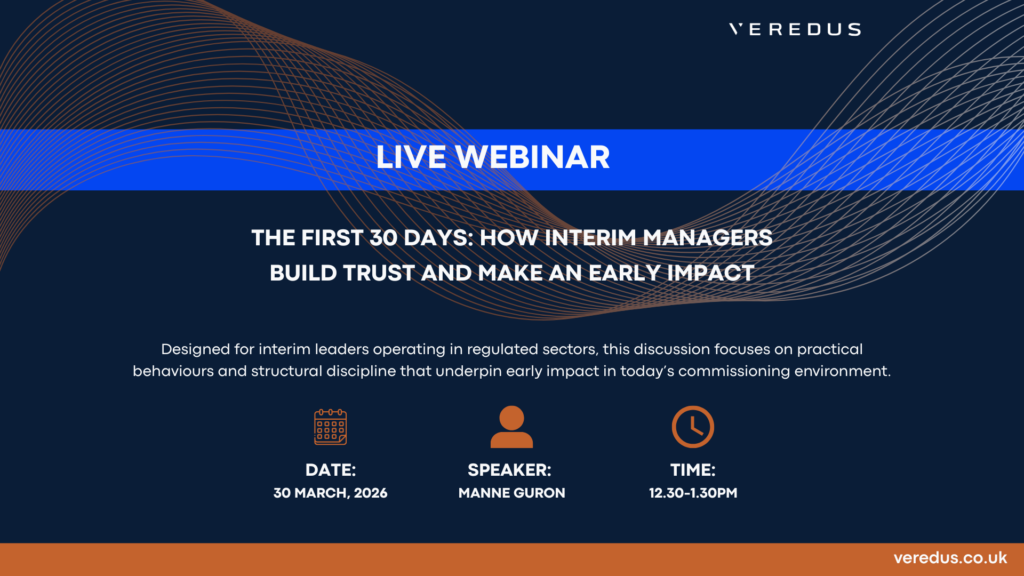
How the first 30 days are shaping interim mandate success in 2026 Veredus will host a webinar for interim leaders exploring how to establish credibility, build trust and create early impact within the first 30 days of a new assignment – a period increasingly recognised as critical to the success of interim mandates. Across regulated sectors including Defence, Government, Transport and Education, expectations around interim leadership have shifted. Organisations are placing greater emphasis on early traction, stakeholder alignment and demonstrable progress, often within compressed timeframes and high-accountability environments. As a result, the initial phase of an interim engagement has become more decisive. Early interactions, behaviours and delivery signals can significantly influence both mandate trajectory and longevity. This session will examine how experienced interim managers navigate this period effectively, combining behavioural insight with practical application. The webinar will be informed by the work of Veredus’ occupational psychologist, drawing on leadership assessment, stakeholder perception and behavioural credibility. These insights will be complemented by reflections from an experienced interim executive, offering a grounded perspective on what drives – and sometimes undermines – early-stage success in live mandates. The discussion will cover: • How interim leaders establish trust quickly within existing leadership teams• The role of perception and behaviour in early mandate credibility• Balancing pace, visibility and governance in high-scrutiny environments• Structuring the first 30 days to demonstrate measurable progress The session is designed for both experienced interim leaders and those considering a move into the interim market, particularly those operating within complex or regulated environments. Webinar: The First 30 Days: How Interim Managers Build Trust and Create Early ImpactDate: 30th March 2026Time: 12.30-1.30pmRegistration: https://forms.gle/SshE4rDL2oSfgkH38
Leadership assessment as a decision discipline

In our work at senior and executive level, leadership assessment is rarely about establishing capability. By the time candidates reach final stages, track record, experience and technical credibility are typically well evidenced. What we are focused on is how that capability will translate into performance within a specific operating environment — and where the risks sit. This distinction is important. Senior leadership roles do not exist in neutral conditions. They are shaped by governance arrangements, regulatory oversight, stakeholder expectations, organisational maturity and, in many cases, public or political scrutiny. These factors materially affect how leadership capability is expressed, tested and experienced. Assessment approaches therefore need to be sensitive to context. Data derived from psychometrics, interviews or exercises can be valuable, but only when interpreted through a clear understanding of the environment in which a leader will operate. Without that lens, assessment risks producing information that is technically sound but operationally limited. In practice, we have found that effective leadership and talent assessment benefits from considering three dimensions together. Leadership capability This includes cognitive ability, experience, technical credibility and leadership repertoire. At senior level, this is often the most visible dimension, but it is only part of the picture. Operating environment Governance structures, regulatory constraints, stakeholder complexity, organisational culture and the degree of scrutiny all shape what effective leadership looks like in practice. The same leader can perform very differently across environments. Decision behaviour This concerns how leaders prioritise, manage risk, respond to challenge and operate under pressure. It is often the least visible dimension, yet one of the most critical in high-stakes roles. When these dimensions are considered in isolation, the resulting view of a leader is partial. Considered together, they allow for a more accurate and defensible assessment of leadership risk and readiness, and provide panels with clearer evidence on which to base decisions. Our Leadership & Talent Assessment practice is led by Chartered Occupational Psychologists with deep experience of senior and executive appointments across public sector and regulated environments. We integrate validated psychometric evidence with structured, psychology-led interviews and bespoke, role-specific assessment design, aligned to the demands of each leadership context. For us, the purpose of leadership assessment at this level is not reassurance. It is to support clear, evidence-based decision-making in roles where the consequences of getting it wrong are significant. That is the standard we believe senior leadership assessment should be held to. Find out more at www.veredus.co.uk.
Navigating senior leadership in a more constrained employment landscape

The Employee Rights Bill is another reminder that senior leadership roles are becoming more constrained – not less. With major provisions due to come into force this year, the Bill signals a shift towards greater protection, increased scrutiny and a narrowing margin for error in senior people decisions – particularly in regulated industries such as Government, Defence, Education and Transport. Not because of the legislation itself – but because of what it signals. Senior leaders are increasingly operating in environments where: Employment risk is higher Decision-making is more visible Flexibility is harder to preserve The consequences of getting senior appointments wrong are amplified In this context, executive recruitment can no longer be treated as a transactional exercise. We’re seeing boards and executive teams rethink how they access senior capability – especially during periods of change or uncertainty. For many, this has led to a more deliberate use of interim leadership: experienced leaders who can step in quickly, operate with authority, and lead through complexity without locking organisations into long-term risk. At Veredus, our role increasingly sits upstream of the appointment itself: Advising on leadership risk and capability gaps Stress-testing roles against the realities of the operating environment Supporting senior appointments – interim and permanent – where judgement, credibility and adaptability matter as much as experience The Employee Rights Bill doesn’t reduce the need for strong leadership. It raises the bar for it. And in constrained, highly regulated environments, confidence in senior appointments is no longer a “nice to have” – it’s a governance issue. Get in touch to discuss your leadership requirements with us.
Here’s what senior leadership looks like this year.

This month, we’ve introduced a refined brand identity for Veredus — one that more clearly reflects the senior leadership work we deliver across executive search, interim management and leadership advisory. It’s a considered evolution, shaped by how leadership expectations are changing and by what our clients and candidates are navigating in practice. Over the past year, we’ve also taken time to reflect on how leadership itself is evolving — and what organisations are increasingly asking of senior leaders. This perspective informs how we talk about our work at Veredus, but more importantly, it reflects what we’re seeing on the ground across complex regulated environments. As organisations plan for 2026, several consistent themes are emerging. 1. Senior roles are expanding in scope Leadership roles are carrying broader responsibility than before. Strategy, delivery, people leadership, governance and stakeholder management are increasingly converging into a single remit. Depth of expertise still matters — but the ability to operate across complexity is becoming just as critical. 2. Interim leadership is being used more deliberately Interim appointments are no longer simply reactive. We’re seeing experienced interim leaders brought in to stabilise teams, lead transformation, manage risk and create momentum during periods of change. Used well, interim leadership is becoming a strategic asset. 3. Judgement is overtaking track record Past success remains important, but it’s no longer sufficient on its own. Organisations are placing greater emphasis on how leaders make decisions under pressure, adapt to uncertainty and lead through ambiguity — particularly in highly regulated or publicly accountable environments. 4. Assessment is becoming more rigorous — and more human There is growing recognition that senior appointments require deeper assessment. Understanding how a leader thinks, influences and responds in complex situations is increasingly valued over automated screening or surface-level indicators. 5. Leadership credibility is under closer scrutiny Senior leaders are operating with less margin for error. Behaviour, values and impact are more visible than ever — internally and externally. Credibility is now built through consistency, trust and the ability to lead responsibly through change. Looking ahead These shifts are shaping appointment decisions now — and they will continue to do so through 2026 and beyond. Through The Leadership Brief, we’ll share perspective drawn from real appointments, interim mandates and advisory work — offering practical insight into how senior leadership is evolving, and what organisations should be thinking about next.
Interim Project Managers x 5 – Rail Delivery Group (RDG)
Background Veredus provide interim executive talent across the transport and infrastructure sector, including many of the UK train operating companies, Network Rail and the Rail Delivery Group. We recruit exceptional individuals across all functions, including HR, Finance, Operations, Engineering, Health and Safety, Procurement, Projects and Programme Management. The challenge The RDG purpose is to create a simpler, better railway for everyone in Britain. As part of this mission the ‘Rail Reform’ programme required a number of experienced project managers to either be part of, or manage workstreams across: Fares, Ticketing, Stations and Technology. The challenge was to identify interim project managers with the requisite skills in such diverse areas as communications, customer experience and stations. In order to achieve this RDG asked us to provide 5 interim project managers. Our solution: We undertook extensive research across multiple infrastructure, transport, utilities and public sector groups together with engaging with our ‘talent bank’ of existing project managers, to identify available skills and experience for these (initial 6 month) assignments. The search activity generated dozens of potential candidates that we met with to produce a shortlist of 12 for final presentation to the client. All 5 appointments were made and contracts have since been extended. We have also been asked to provide additional resource on an interim basis.