
The New Operating Model of Public Sector Leadership

Every executive search gives us a window into how organisations are changing. Over the past year, we’ve seen a noticeable increase in organisations redesigning executive teams before they come to market. New leadership portfolios are emerging across central government, higher education, transport, infrastructure and arm’s-length bodies, with growing demand for Deputy Chief Executives, Chief Operating Officers, Chief Transformation Officers and Executive Directors of Delivery. These appointments reflect a broader evolution in public sector leadership. Executive teams are being configured around transformation, programme delivery, digital capability, commercial leadership and organisational performance, alongside their more traditional responsibilities. It’s a trend we’ve been watching closely because executive structures often reveal where organisations believe their biggest challenges – and opportunities – lie. From strategy to delivery Much has been written about the scale of change facing the public sector, but less attention has been given to what that means for executive leadership. Across our markets, organisations are balancing long-term transformation with the demands of day-to-day delivery. Universities are responding to financial sustainability and changing student expectations. Government departments and ALBs are delivering increasingly complex policy programmes. Transport and infrastructure organisations are managing major investment alongside operational performance, regulatory requirements and decarbonisation. Defence organisations are scaling capability at pace while responding to a rapidly changing geopolitical landscape. The common denominator is delivery. Many of these priorities sit alongside one another rather than replacing each other. As a result, organisations are creating executive capacity in areas that have become strategically critical. Executive portfolios are evolving Titles differ from one organisation to another, but the underlying themes are remarkably consistent. We’re seeing greater demand for executives responsible for transformation, organisational performance, programme delivery, digital, commercial operations and cross-functional change. In some organisations, these responsibilities sit with a Deputy Chief Executive or Chief Operating Officer. Elsewhere, they’re reflected in newly created Chief Transformation Officer positions or Executive Directors with responsibility for strategy and delivery. These roles rarely exist in isolation. They are designed to coordinate programmes that cut across organisational boundaries, align multiple stakeholders and maintain momentum over several years. That’s a very different remit from the operational leadership portfolios many of these roles would have carried even five years ago. Organisation design is becoming part of the leadership conversation One of the more interesting developments is that conversations increasingly begin with executive structure rather than individual appointments. Boards and Chief Executives are asking whether existing portfolios reflect the organisation’s priorities, whether executive capacity is aligned to future delivery requirements, and whether responsibilities should be redistributed before recruitment begins. For some organisations, that means creating entirely new executive roles. For others, it means redefining existing portfolios or bringing in interim leadership to establish new functions before making permanent appointments. Executive search is becoming one part of a much broader discussion about leadership capability. Looking ahead Executive structures have always evolved in response to changing priorities. Today’s priorities include digital transformation, AI adoption, financial sustainability, infrastructure investment, organisational reform and increasingly complex stakeholder environments. They demand executive leadership with the time, experience and authority to drive delivery at scale. We expect this trend to continue as organisations continue to adapt to new policy, funding and operational challenges. The titles may differ, but the direction of travel is becoming increasingly clear. Public sector organisations are reshaping executive leadership around the capabilities required to deliver long-term transformation, not simply to manage today’s organisation. Get in touch to discuss your leadership requirements.
Veredus appointed to the Government Commercial Agency’s RM6394 framework
Veredus is pleased to announce its appointment to the Government Commercial Agency’s Executive & Non-Executive Search 3 Framework (RM6394), providing public sector organisations with a compliant and efficient route to access our Executive Search, Interim Management and Leadership Advisory services. The framework has been designed to simplify the procurement of senior leadership solutions, enabling organisations to engage pre-qualified suppliers through an established commercial route. By reducing procurement timescales and administrative complexity, RM6394 allows organisations to focus on what matters most – securing the leadership capability needed to deliver organisational priorities. Supporting leadership across the public sector For decades, Veredus has partnered with organisations across central government and the wider public sector, supporting critical leadership appointments and organisational transformation. Our appointment to RM6394 reflects that experience and provides clients with access to a broad range of leadership solutions through a single framework. Executive Search Every executive appointment presents different challenges, governance requirements and stakeholder expectations. Our modular Executive Search methodology enables organisations to access the level of support appropriate to each assignment, whether that’s executive market mapping, leadership assessment, candidate benchmarking or a fully retained executive search campaign. This proportionate approach ensures every appointment is aligned to organisational priorities while maintaining the governance and assurance expected through RM6394. Interim Management Leadership requirements don’t always follow a permanent recruitment timetable. Periods of transformation, machinery of government change, financial recovery and major programme delivery often require experienced executive capacity at pace. Through RM6394, organisations can access Veredus’ network of senior interim leaders with extensive experience across government and the wider public sector, providing immediate capability to maintain momentum and strengthen delivery. Leadership Advisory Executive Search is increasingly just one part of effective leadership planning. Leadership Advisory enables organisations to define future leadership requirements before recruitment begins, supporting organisational design, succession planning, executive assessment, leadership capability and board effectiveness. By combining public sector insight, market intelligence and leadership assessment, we help organisations make informed leadership decisions that support long-term organisational objectives. A strategic partner for public sector leadership The challenges facing public sector organisations continue to evolve. Financial pressures, workforce reform, transformation programmes and increasing public scrutiny mean leadership decisions have never been more significant. RM6394 provides a trusted and compliant framework through which organisations can access the expertise required to address those challenges. Whether the requirement is Executive Search, Interim Management or Leadership Advisory, Veredus brings extensive public sector experience, independent judgement and a collaborative approach to every engagement. If you’d like to discuss how RM6394 can support your organisation’s leadership requirements, we’d be delighted to start the conversation. DOWNLOAD THE FRAMEWORK BROCHURE HERE.
Executive Conversations: Belinda Phipps on Leadership Under Pressure
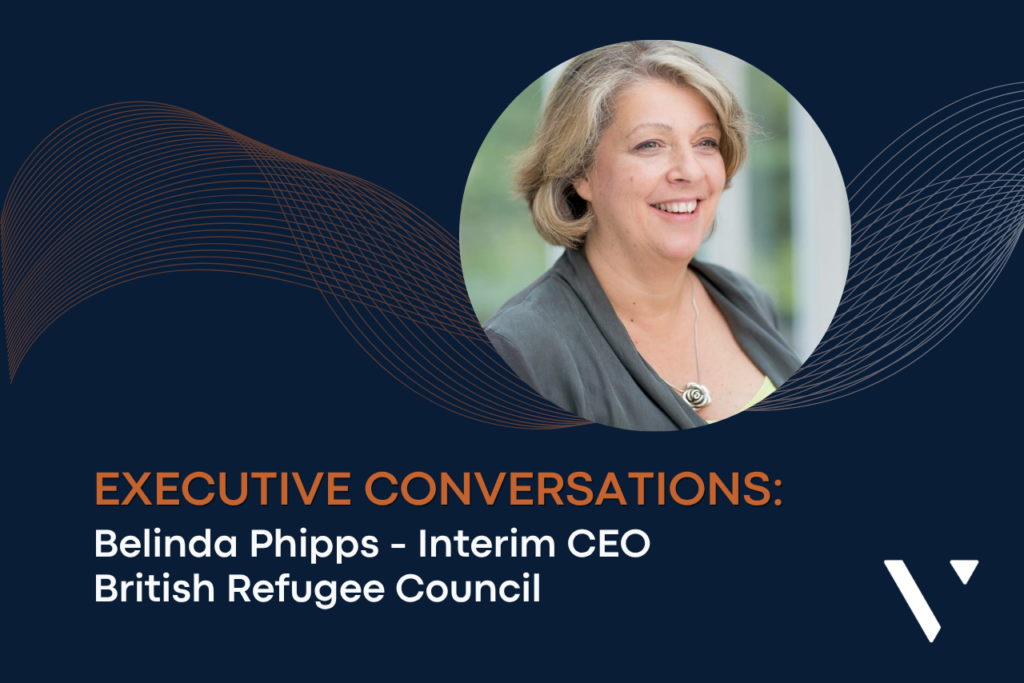
What does it really take to lead when the consequences of failure are significant, uncertainty is constant, and every decision carries weight? In this edition of Leadership Conversations, Simon Pickerell speaks with Belinda Phipps, Interim Chief Executive of the British Refugee Council, about the realities of leading complex organisations through periods of significant change. Drawing on a career spanning healthcare, the public sector and the charity sector, Belinda reflects on the experiences that have shaped her leadership approach, from her first chief executive role in the NHS to leading transformation in organisations facing financial, operational and societal pressures. Together, they explore what creates a genuine burning platform for change, how to build momentum in the face of scepticism, why the most effective leaders focus on solving dilemmas rather than accepting compromise, and the personal resilience required to lead when the stakes are high. — 1. What first drew you to transformation work? Was there a defining moment early in your career? Early in my career, the defining moment came when I took on my first chief executive role, leading the regional Blood Transfusion Service for the South East. I arrived feeling proud and excited, and like any new CEO, I went out to see how things worked on the ground. On only my second or third day, I visited the team that takes orders from hospitals for blood products. I stood and listened as call handlers repeatedly told hospitals they couldn’t have what they were asking for, effectively negotiating and arguing over orders. In my naivety, I asked what would happen if we didn’t deliver the blood. The answer was that operations would be delayed or cancelled. Then I asked, “What happens if it’s an emergency?” There was a deathly silence. The unspoken truth was that the patient might not get the blood they needed and might not survive. That was a chill‑down‑the‑spine moment. I suddenly understood that I was responsible for an organisation that could, in effect, be contributing to people dying if it failed. I had to ask myself, “Do I really want to do this?” Because if I stayed, then I had to fix it. Fresh from an MBA, I decided to radically change how the service operated so it could reliably provide the blood required. My initial toolkit wasn’t enough, so I went back for more help and brought in a different methodology. Within about 18 months, we had enough blood not only for our own region but also to support other centres, and we stopped missing orders. The transformation changed everything. We went from the fear of failing patients to the pride of staff who were genuinely delighted with what they were achieving and hungry to improve further. That success helped drive a national merger of the separate blood services, so the same approach could be rolled out everywhere. Seeing that kind of turnaround, the impact on patients and the pride in staff, can be almost addictive. That experience was my entry point into real transformation work 2. What was the real burning platform that convinced you this transformation was non‑negotiable? In the blood service, the burning platform was stark: you cannot be killing people. If the organisation fails to deliver blood when it’s needed, you are putting lives at risk. In that situation, transformation isn’t a strategic option—it’s an ethical necessity. Continuing as you are simply isn’t morally defensible. In other transformations I’ve led, the burning platform has often been financial and existential. Organisations reach a point where their financial sustainability, and therefore their future, is in serious doubt. By the time I’m asked to step in, most of the incremental fixes have already been tried. So the burning platform often sounds like: “We’re running out of options. If we carry on like this, we may not survive.” At that point, a significant transformation, not just marginal change, is non‑negotiable. 3. What has been the most difficult trade‑off you’ve had to make in a transformation so far? I’m actually not a great believer in trade‑offs as they’re commonly framed. “Trade‑off” often becomes a respectable word for “we’ve decided to compromise,” and that can be a sign we haven’t done enough deep thinking. Take the NHS as an example. The system constantly wrestles with three pressures: The typical response is to “balance” these, focus on one at the expense of the others, then shift back again. You end up institutionalising a permanent sense of compromise. Whenever I’m told, “This is a trade‑off,” I try to treat it instead as a dilemma to be solved. I ask: how can we improve quality and quantity of service, and be financially sustainable at the same time? It’s not that everything is easy or that you never make hard calls, but often, when you really apply yourself to the problem, you can find creative win‑win solutions instead of living forever with unhappy compromises. The real work of transformation is less about tolerating trade‑offs and more about resolving long‑standing dilemmas that people have assumed are unfixable. 4. How do you bring sceptics and “fence sitters” in the organisation along on the journey? At the beginning, I don’t. Every organisation has three groups: If you start by focusing on sceptics and fence sitters, you burn a lot of time and emotional energy for very little progress. So early on, I focus on finding and working with the willing. I have a lot of individual conversations to identify those who really want to give change a go. I then work closely with them to build momentum and deliver visible progress. Once things are moving and good things start to happen, the dynamics change: In short, I lead with the willing, let success become the persuader, and allow sceptics to make their own decisions once the direction of travel is obvious. 5. Can you share a moment when a transformation nearly went off the rails, and what you did about it? When a transformation feels like it’s going off the rails, my first move is to look in the mirror. In my experience, things often wobble when: Transformations are emotionally intense. They involve high stakes, conflict, and