
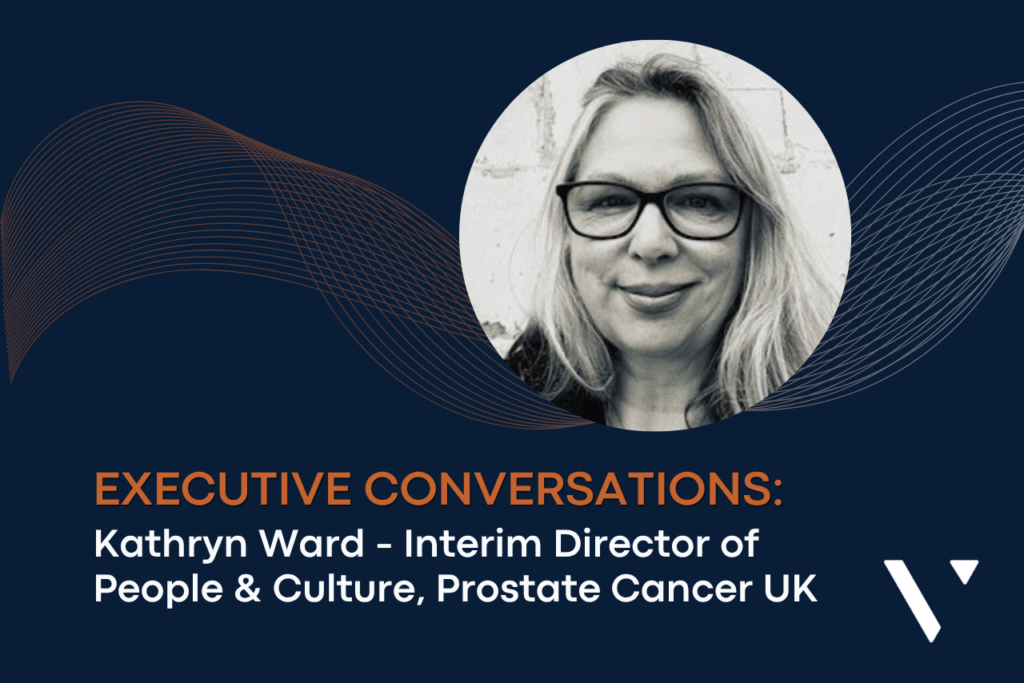
As more organisations look for senior expertise without the cost and rigidity of a full-time executive, fractional and interim leadership is becoming an increasingly powerful option – especially in the charity sector.
In this conversation, Simon Pickerell talks with Kathryn Ward, an experienced Chief People Officer and fractional leader, about why she chose this path, how she protects her energy, and what organisations need to know before bringing in a fractional executive.
What first drew you to fractional and interim work rather than a single permanent role?
I’ve enjoyed my permanent leadership roles, but I reached a point where I wanted to have a broader impact.
Many organisations don’t need a full-time strategic HR leader, but they do need senior people expertise. Fractional leadership allows me to work alongside executive teams and boards on the strategic questions – how people enable organisational strategy, how leadership evolves, and how organisations build capability – while supporting multiple charities rather than just one.
What appealed to me wasn’t consultancy alone; it was becoming part of the leadership journey. Building long-term relationships, helping organisations develop their own capability, and contributing where I can make the greatest difference.
Outside of work, what’s something you do that actually makes you a better leader when you’re back in the room?
It might sound slightly clichéd, but yoga.
More broadly though, it’s about creating space. Whether that’s yoga, reading, listening to a podcast or simply switching off for a while; making space helps me stay grounded.
Leadership constantly brings competing priorities, emotion and uncertainty. If you know where your own centre is, you can empathise with what’s happening around you without being pulled off balance yourself. That gives you the headspace to make good decisions rather than reactive ones.
It also keeps you connected to your values. Whether that’s through journaling, coaching, meditation or other reflective practices, understanding what matters to you makes you a clearer, more consistent leader.
What’s a piece of advice, professional or personal, that’s stuck with you throughout your career?
There are two.
The first came when I stepped into my role at Guide Dogs and everything felt bigger than I’d anticipated. A coach said to me: “It can be hard, and you can still be doing a good job.”
I’ve never forgotten that. Stepping into a bigger leadership role should feel challenging. Just because something is hard doesn’t mean it’s wrong, or that you’re not the right person for it.
The second is: “If not you, then who?”
Sometimes that’s about delegation – recognising you can’t do everything yourself. Other times it’s about having the courage to speak up when you see something that needs saying. Both are reminders of what leadership really requires. They’re still written on sticky notes next to my computer today.
How do you protect your own energy and wellbeing while working across multiple demanding roles?
The first thing is knowing whether this style of work genuinely suits you.
I get energy from variety. Moving between different organisations, challenges and groups of people keeps me engaged, but that’s not true for everyone. If variety drains you rather than energises you, this probably isn’t the right model.
Beyond that, it’s about understanding your own energy. I know when I’m at my best for one-to-one conversations, when I’m better facilitating larger groups, and how much energy different clients and different types of work require. I structure my diary around that wherever I can.
I also build in transition points. That might be going for a walk, listening to music or simply stepping away from my desk. Sometimes, when you work from home, you even need to create your own commute – walk out of the front door and back in again if that’s what helps you mentally switch between roles. It’s about understanding what allows you to show up well, wherever you’re working.
When you walk into a new organisation for the first time, what’s the one thing you assess in the first week that tells you what the real priorities are?
Consistency.
In those first couple of weeks, I’ll speak to people right across the organisation. What I’m listening for isn’t whether everyone uses exactly the same words – it’s whether they’re telling broadly the same story.
If senior leaders, middle managers and frontline teams all describe the culture and strategy in a broadly consistent way, you’ve got something to work with, even if that culture isn’t perfect.
Where the stories differ dramatically, that’s usually where the real work begins. Those inconsistencies often point to issues around communication, leadership alignment or culture, and understanding those gaps tells you a great deal about what the organisation really needs.
What’s a piece of work or a turnaround you’re proudest of that you couldn’t have achieved in a traditional, permanent role?
One of the biggest advantages of coming into an organisation as a fractional or interim leader is bringing fresh perspective.
When you’re already part of the system, it’s naturally harder to question how that system works. Coming in from outside gives you permission to ask different questions about leadership structures, organisational design and how functions work together.
You’re also able to bring insight from other organisations and benchmark what’s happening elsewhere. Sometimes the greatest value isn’t having all the answers – it’s helping leadership teams ask questions they hadn’t considered before. That’s something I really enjoy about this way of working.
What’s the biggest misconception organisations have about hiring a fractional or interim executive?
One of the biggest misconceptions is that they don’t need one because someone is already “doing” that role.
There’s a real difference between someone delivering the day-to-day function and someone providing strategic leadership. Whether it’s people, finance, digital or AI, organisations often stretch existing teams rather than stepping back and asking what expertise they actually need.
Another challenge is that decisions are often made informally – someone knows someone who can help. Fractional leadership works best when organisations take a more strategic approach, defining the capability they need rather than simply relying on existing networks.
What’s one thing every organisation should have in place before bringing in a fractional executive?
Probably less than they think.
I don’t believe you need a fully defined brief before bringing someone in. Often, the first step is simply recognising there’s a strategic challenge, setting aside some budget and being clear about the direction you need help in.
I tend to think about it in two phases.
The first is a discovery phase, where you work with someone to understand the challenge, define the outcomes, establish the return on investment and agree what success looks like.
The second is the ongoing fractional role, where you bring in the right person to deliver against that plan. That might be the same person who supported the discovery phase, or it might be someone different – and that’s absolutely fine.
You don’t need all the answers before asking for help. Sometimes bringing in the right expertise is exactly what helps you define the problem in the first place.