
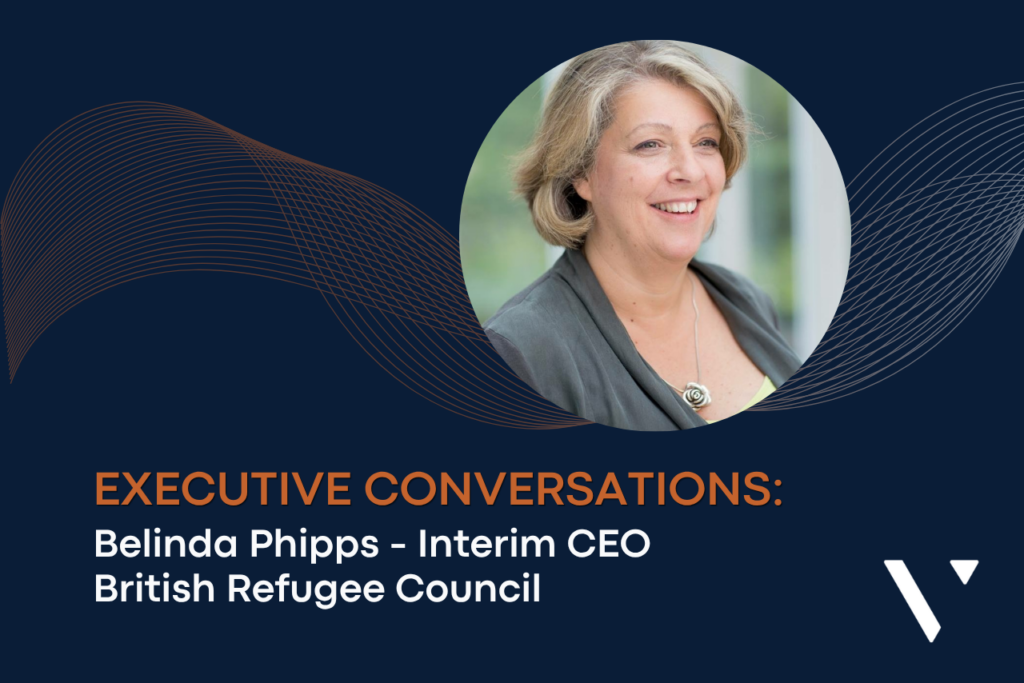
What does it really take to lead when the consequences of failure are significant, uncertainty is constant, and every decision carries weight?
In this edition of Leadership Conversations, Simon Pickerell speaks with Belinda Phipps, Interim Chief Executive of the British Refugee Council, about the realities of leading complex organisations through periods of significant change.
Drawing on a career spanning healthcare, the public sector and the charity sector, Belinda reflects on the experiences that have shaped her leadership approach, from her first chief executive role in the NHS to leading transformation in organisations facing financial, operational and societal pressures.
Together, they explore what creates a genuine burning platform for change, how to build momentum in the face of scepticism, why the most effective leaders focus on solving dilemmas rather than accepting compromise, and the personal resilience required to lead when the stakes are high.
—
1. What first drew you to transformation work? Was there a defining moment early in your career?
Early in my career, the defining moment came when I took on my first chief executive role, leading the regional Blood Transfusion Service for the South East. I arrived feeling proud and excited, and like any new CEO, I went out to see how things worked on the ground.
On only my second or third day, I visited the team that takes orders from hospitals for blood products. I stood and listened as call handlers repeatedly told hospitals they couldn’t have what they were asking for, effectively negotiating and arguing over orders.
In my naivety, I asked what would happen if we didn’t deliver the blood. The answer was that operations would be delayed or cancelled. Then I asked, “What happens if it’s an emergency?” There was a deathly silence. The unspoken truth was that the patient might not get the blood they needed and might not survive.
That was a chill‑down‑the‑spine moment. I suddenly understood that I was responsible for an organisation that could, in effect, be contributing to people dying if it failed. I had to ask myself, “Do I really want to do this?” Because if I stayed, then I had to fix it.
Fresh from an MBA, I decided to radically change how the service operated so it could reliably provide the blood required. My initial toolkit wasn’t enough, so I went back for more help and brought in a different methodology. Within about 18 months, we had enough blood not only for our own region but also to support other centres, and we stopped missing orders.
The transformation changed everything. We went from the fear of failing patients to the pride of staff who were genuinely delighted with what they were achieving and hungry to improve further. That success helped drive a national merger of the separate blood services, so the same approach could be rolled out everywhere.
Seeing that kind of turnaround, the impact on patients and the pride in staff, can be almost addictive. That experience was my entry point into real transformation work
2. What was the real burning platform that convinced you this transformation was non‑negotiable?
In the blood service, the burning platform was stark: you cannot be killing people. If the organisation fails to deliver blood when it’s needed, you are putting lives at risk. In that situation, transformation isn’t a strategic option—it’s an ethical necessity. Continuing as you are simply isn’t morally defensible.
In other transformations I’ve led, the burning platform has often been financial and existential. Organisations reach a point where their financial sustainability, and therefore their future, is in serious doubt. By the time I’m asked to step in, most of the incremental fixes have already been tried.
So the burning platform often sounds like: “We’re running out of options. If we carry on like this, we may not survive.” At that point, a significant transformation, not just marginal change, is non‑negotiable.
3. What has been the most difficult trade‑off you’ve had to make in a transformation so far?
I’m actually not a great believer in trade‑offs as they’re commonly framed. “Trade‑off” often becomes a respectable word for “we’ve decided to compromise,” and that can be a sign we haven’t done enough deep thinking.
Take the NHS as an example. The system constantly wrestles with three pressures:
- Quality of care
- Quantity/access (how many people you can treat)
- Financial sustainability
The typical response is to “balance” these, focus on one at the expense of the others, then shift back again. You end up institutionalising a permanent sense of compromise.
Whenever I’m told, “This is a trade‑off,” I try to treat it instead as a dilemma to be solved. I ask: how can we improve quality and quantity of service, and be financially sustainable at the same time?
It’s not that everything is easy or that you never make hard calls, but often, when you really apply yourself to the problem, you can find creative win‑win solutions instead of living forever with unhappy compromises.
The real work of transformation is less about tolerating trade‑offs and more about resolving long‑standing dilemmas that people have assumed are unfixable.
4. How do you bring sceptics and “fence sitters” in the organisation along on the journey?
At the beginning, I don’t. Every organisation has three groups:
- The people who already have “the bit between their teeth” are keen, they care, and they’ve been trying to improve things.
- The fence sitters, who will follow whichever direction seems to be winning.
- The sceptics and resisters, who are against the change or deeply doubtful about it.
If you start by focusing on sceptics and fence sitters, you burn a lot of time and emotional energy for very little progress.
So early on, I focus on finding and working with the willing. I have a lot of individual conversations to identify those who really want to give change a go. I then work closely with them to build momentum and deliver visible progress.
Once things are moving and good things start to happen, the dynamics change:
- The fence sitters usually follow the energy and the results.
- The sceptics face a choice. Some join in once it’s clear the change is real. Others become increasingly frustrated that their predictions of failure haven’t come true and may choose to leave the organisation.
In short, I lead with the willing, let success become the persuader, and allow sceptics to make their own decisions once the direction of travel is obvious.
5. Can you share a moment when a transformation nearly went off the rails, and what you did about it?
When a transformation feels like it’s going off the rails, my first move is to look in the mirror.
In my experience, things often wobble when:
- I’ve allowed myself to become too emotionally entangled, or
- I’ve become tired and overstretched, and I start taking shortcuts.
Transformations are emotionally intense. They involve high stakes, conflict, and real pressure. You can’t go through that without it affecting you. But if you let that seep into how you show up as a leader, the transformation will start to reflect your emotional state.
When I sense that happening, the counter‑intuitive answer is not to double down and push harder. It’s to step back:
- I take time to rest and recover.
- I talk to someone outside the situation who can help me see it more clearly.
- I focus on getting myself back into a stable, grounded place.
Once I’ve done that, I come back with more clarity and composure, which usually has a stabilising effect on the whole program.
Often, the point where it feels like the transformation is going off the rails is really the point where the leader at the centre needs re-centring.
6. Who are the leaders, inside or outside business, who have most inspired your approach to change?
I’ve read widely and learned from many leadership thinkers, but a couple of people I’ve worked with directly have shaped me profoundly.
Julia Cumberlege gave me my first role in the blood service. On paper, I wasn’t the obvious choice: wrong sex, wrong age, and I’d just had a baby. Watching her in action was formative. She had an extraordinary ability to ask very incisive questions in a wonderfully charming way. People didn’t feel attacked, but they did find themselves thinking much more deeply.
From her, I learned the power of questions over instructions, helping people think, rather than telling them what to do.
My first chair, Gordon Howe from Ernst & Young, taught me a different but equally powerful skill. He could have what seemed like a casual, inconsequential conversation, and during it, almost without noticing, the other person would change their mind. It was a masterclass in subtle influence.
I observed him very carefully and hoped to absorb even a fraction of that skill, because in transformation, the ability to shift people’s thinking gently but decisively can be transformational in itself.
Those two, alongside a wide range of thinkers and practitioners, have deeply influenced my approach to leading change.
7. What personal values guide your decisions when there’s no obvious “right” answer?
Two core values guide me when the path isn’t clear.
First, doing the right thing for beneficiaries or customers.
The central question is always: “What is the right thing for the people this organisation exists to serve?” Sometimes doing the right thing involves saying or doing uncomfortable things, challenging colleagues, confronting unwelcome truths, or insisting on changes that others resist. But that’s the job.
Second, honesty and clarity when the way forward is uncertain.
There are times when you simply don’t know which option is best. In those moments, I believe in being open and transparent:
- Explain what you’re doing and why.
- Be explicit about what you don’t know.
- Share the uncertainties rather than pretending they don’t exist.
Being truthful and clear, especially about ambiguity, builds trust, even when you can’t provide guarantees or perfect answers.
Those two values, relentless focus on the people you serve, and honesty about what you know and don’t know, are my compass when the map runs out.
8. If you could give one piece of advice to future CEOs leading their first major transformation, what would it be?
There’s a lot you can and should do to prepare:
- Study hard.
- Take qualifications like an MBA.
- Learn the frameworks, models, and tools of transformation.
All of that matters. But you can have every tool in the book and still find that it’s not enough.
My single biggest piece of advice is: work on yourself.
- Become as comfortable in your own skin as you can.
- Develop your resilience, so you can hold steady under conflict and pressure.
- Learn to recognise your own triggers, so you’re less likely to react in ways you later regret.
Your aim is to become an “island of peace” in the middle of the storm, someone people can rely on, who doesn’t need to be carefully managed around, and who doesn’t periodically explode or withdraw in ways that destabilise the organisation.
You’ll never be perfect at that, but if, each year, you get a little better, you will become dramatically more effective at leading transformation.
So my advice is:
Invest at least as much in your own inner stability and self‑awareness as you do in your technical skills.
That, more than any single framework or tool, will determine how well you can lead major change.